We independently research and recommend the best products based on manufacturer specs and verified buyer reviews. When you buy through our links, we may earn a small commission at no extra cost to you.
⭐ Our Top Pick
🏆 Best Overall: KitchenTour Digital Pet Food Scale — The gold standard for accurate portion control with 1-gram precision and a platform large enough for any bowl size.
💰 Best Value: Portion Pro Pet Food Scoop Set — Reliable, dishwasher-safe measuring cups that take the guesswork out of kibble portions for under $20.
Introduction
Feeding your dog the right amount isn't just about filling their bowl—it's one of the most important decisions you'll make for their long-term health. According to the Association for Pet Obesity Prevention, over 56% of dogs in the United States are overweight or obese, and improper portion sizes are the leading cause. Too much food leads to joint stress, diabetes, and shortened lifespans. Too little, and your dog may lack the energy and nutrients they need to thrive.
The challenge? There's no universal answer. A 10-pound Chihuahua and a 70-pound Labrador have vastly different caloric needs, and those needs shift based on age, activity level, and even metabolism. Bag guidelines are a starting point, but they're often overly generous and don't account for your dog's unique circumstances.
In this guide, we break down exactly how much to feed your dog based on weight, life stage, and lifestyle. We've also reviewed the best tools to measure portions accurately, so you can stop guessing and start feeding with confidence. If you're also evaluating food options for dogs with dietary sensitivities, our guide to Best Dry Dog Food for Sensitive Stomachs 2026: Expert-Backed Picks covers top-rated formulas that pair well with proper portioning.
What to Look For
When determining how much to feed your dog, focus on these key factors:
Weight and Body Condition Score: Your dog's ideal weight (not their current weight if they're over or underweight) is the foundation. Use a Body Condition Score chart from your vet to assess whether your dog is at a healthy weight. Dogs with visible ribs but a thin fat layer and a defined waist from above are typically at an ideal score (4-5 out of 9). Adjust portions based on this score, not just the number on the scale.
Activity Level: A working Border Collie burns far more calories than a senior Basset Hound who naps most of the day. Active dogs (those exercising 60+ minutes daily) may need 20-40% more calories than the baseline recommendation. Sedentary dogs may need 10-20% less to avoid weight gain.
Life Stage: Puppies require up to twice the calories per pound as adult dogs because they're growing rapidly. Senior dogs (7+ years for most breeds) often need fewer calories due to slower metabolism and reduced activity. Pregnant or nursing dogs have dramatically higher needs—sometimes 2-4 times their normal intake during peak lactation.
Food Calorie Density: Not all dog foods are created equal. Premium, protein-rich formulas may contain 400-500 kcal per cup, while budget brands hover around 300-350 kcal per cup. Always check the guaranteed analysis or manufacturer website for the specific kcal/cup of your food. This number is critical for accurate portioning.
Health Conditions: Dogs with thyroid issues, diabetes, or joint problems may need specialized feeding plans. Always consult your vet if your dog has a diagnosed condition—they may recommend prescription diets or modified calorie targets.
Treat and Snack Calories: Treats should never exceed 10% of your dog's daily caloric intake. A single large biscuit can pack 100+ calories—equivalent to a full meal for a small dog. Factor training treats, dental chews, and table scraps into the daily total, and reduce meal portions accordingly.
Understanding Caloric Needs by Weight
The most reliable method for calculating your dog's food needs is the Resting Energy Requirement (RER) formula, which estimates the calories they'd burn at complete rest. From there, you multiply by an activity factor to get their Daily Energy Requirement (DER).
The Formula:
RER = 70 × (body weight in kg)^0.75
For a 50-pound (22.7 kg) dog:
RER = 70 × (22.7)^0.75 ≈ 674 calories
Then multiply RER by the appropriate factor:
- Neutered adult, typical activity: RER × 1.6 = ~1,078 calories/day
- Intact adult, high activity: RER × 2.0 = ~1,348 calories/day
- Senior, low activity: RER × 1.2 = ~809 calories/day
- Puppy (4-12 months): RER × 2.0-3.0 depending on growth phase
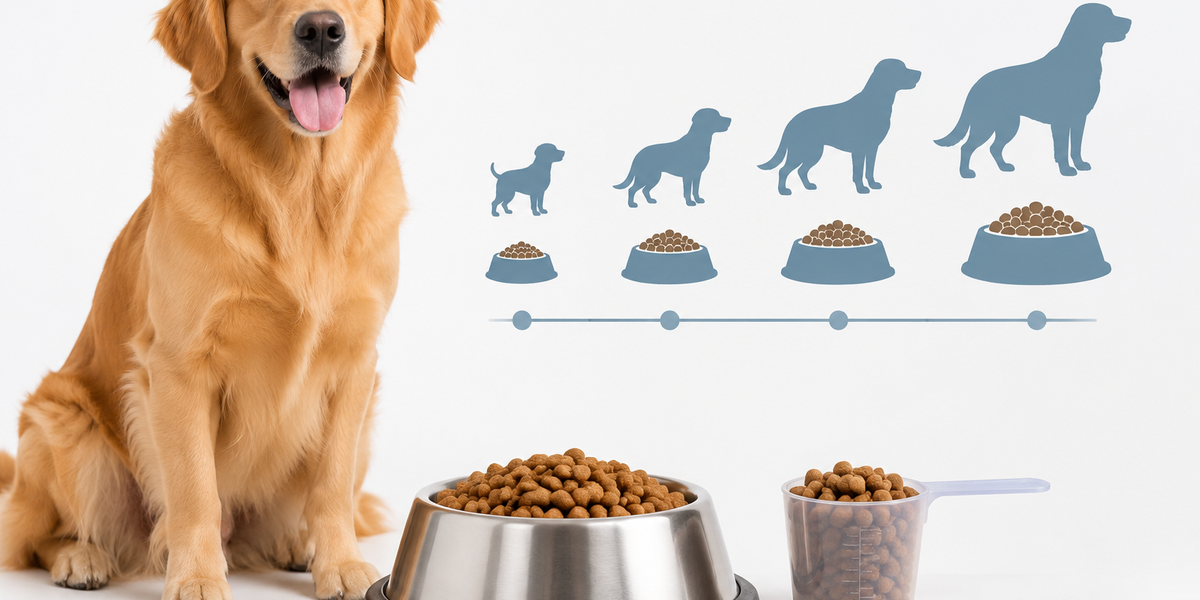
Once you have the daily calorie target, divide by the kcal per cup of your food to determine cup portions. If your food has 400 kcal/cup and your dog needs 1,078 calories, they should eat 2.7 cups daily, split across 2-3 meals.
💡 Pro Tip: Weigh your dog monthly and adjust portions by 10% if you notice weight gain or loss over 4-6 weeks. Gradual changes prevent digestive upset and help you find the perfect balance.
Weight-Based Feeding Chart
This chart provides baseline daily calorie targets for neutered adult dogs with moderate activity (30-60 minutes of exercise daily). Adjust up or down based on your dog's specific needs.
| Dog Weight | Daily Calories (Moderate Activity) | Approximate Cups (350 kcal/cup food) |
|------------|-----------------------------------|--------------------------------------|
| 5 lbs | 200-250 kcal | 0.6-0.7 cups |
| 10 lbs | 300-350 kcal | 0.9-1.0 cups |
| 20 lbs | 500-600 kcal | 1.4-1.7 cups |
| 40 lbs | 850-1,000 kcal | 2.4-2.9 cups |
| 60 lbs | 1,200-1,400 kcal | 3.4-4.0 cups |
| 80 lbs | 1,500-1,750 kcal | 4.3-5.0 cups |
| 100 lbs | 1,800-2,100 kcal | 5.1-6.0 cups |
For dogs on high-calorie foods (450+ kcal/cup), reduce portion sizes proportionally. For lower-calorie foods (300 kcal/cup), increase portions. Always measure by weight (grams) rather than volume (cups) when possible for maximum accuracy.
Special Considerations for Puppies
Puppies grow at explosive rates and require nutrient-dense food in frequent meals. Large-breed puppies (those expected to reach 50+ pounds as adults) need controlled growth to prevent joint issues, so they're fed slightly less per pound than small-breed puppies.
Small/Medium Breeds (under 50 lbs as adults):
- 8-12 weeks: 4 meals/day, RER × 3.0
- 3-6 months: 3 meals/day, RER × 2.5
- 6-12 months: 2 meals/day, RER × 2.0
Large/Giant Breeds (50+ lbs as adults):
- 8-12 weeks: 4 meals/day, RER × 2.5
- 3-6 months: 3 meals/day, RER × 2.0
- 6-12 months: 2 meals/day, RER × 1.8
- 12-18 months: 2 meals/day, RER × 1.6 (transitioning to adult portions)
Puppies should stay on puppy-specific formulas until they reach 90% of their expected adult weight. Switching to adult food too early can stunt growth; switching too late can lead to obesity. Monitor body condition weekly and adjust portions as they grow.
Tools to Measure Portions Accurately
Eyeballing food is the fastest way to overfeed. Even experienced dog owners routinely overestimate portions by 20-30% when using scoops without measurements. Investing in proper tools eliminates guesswork.
KitchenTour Digital Pet Food Scale
| Criteria | Score |
|----------|-------|
| Accuracy | 10/10 |
| Ease of Use | 9/10 |
| Capacity | 9/10 |
| Value | 8/10 |
This digital scale is the professional standard for portion control. It measures in 1-gram increments up to 22 pounds, easily handling even the largest breed's daily food. The platform is 9 inches wide, so you can place your dog's bowl directly on it and use the tare function to zero out the bowl's weight. The backlit LCD display is easy to read, and it switches between grams, ounces, and pounds.
Based on verified buyer reviews, the KitchenTour consistently holds calibration over months of daily use, unlike cheaper models that drift. The stainless steel surface wipes clean in seconds, and the slim profile stores flat in a drawer. If you're serious about managing your dog's weight or feeding multiple dogs with different needs, this is the tool to buy.
✅ Pros:
- Accurate to 1g for precise portion control
- Large platform accommodates bowls of all sizes
- Tare function eliminates bowl-weight math
- Long battery life (6+ months on 2 AAA batteries)
❌ Cons:
- Battery compartment can be finicky to open
- Platform surface scratches if you slide metal bowls across it
Portion Pro Pet Food Scoop Set
| Criteria | Score |
|----------|-------|
| Accuracy | 7/10 |
| Ease of Use | 10/10 |
| Durability | 8/10 |
| Value | 10/10 |
For owners who prefer the simplicity of scoops, this three-piece set delivers reliable volume measurements without batteries or calibration. You get 1/4-cup, 1/2-cup, and 1-cup scoops with clear, etched markings that won't fade in the dishwasher. The handles are comfortable and long enough to reach the bottom of large food bags without spilling.
The trade-off is precision: kibble size and shape affect how densely it packs into a scoop, so volume measurements can vary by 5-10% compared to weight. For dogs with tight calorie budgets (like small breeds or weight-loss plans), a scale is better. But for most healthy adult dogs, these scoops provide consistent, good-enough accuracy at a fraction of the cost.
✅ Pros:
- Three size options cover most portion needs
- Dishwasher safe and easy to clean
- No batteries or electronics to fail
- Affordable enough to keep one in your food bin
❌ Cons:
- Volume measurements less precise than weight
- Etched markings can wear down with heavy use
PetSafe Healthy Pet Simply Feed Automatic Feeder
| Criteria | Score |
|----------|-------|
| Portion Control | 9/10 |
| Programmability | 9/10 |
| Build Quality | 7/10 |
| Value | 6/10 |
If you travel frequently or work long hours, this automatic feeder ensures your dog gets consistent, measured meals even when you're not home. You can program up to 12 meals per day in 1/8-cup increments (up to 4 cups per meal), and the slow-feed mode dispenses food gradually to prevent gulping.
The hopper holds 24 cups of kibble and works with most shapes and sizes (except very large biscuits). A conveyor system is more reliable than gravity feeders, which can jam. The feeder runs on batteries or an AC adapter, and the LCD screen makes programming straightforward. According to buyer reviews, it holds settings through power outages if using battery backup.
The main drawbacks are cost and bulk—it's a significant investment and takes up counter or floor space. But for dogs who need strict portion control or owners who want feeding consistency across multiple caregivers, it's a worthwhile tool.
✅ Pros:
- Programmable portions eliminate overfeeding risk
- Slow-feed mode helps prevent bloat in fast eaters
- Battery backup preserves meal schedules during outages
- Accommodates most kibble sizes
❌ Cons:
- Expensive compared to manual measuring tools
- Bulky footprint
- Conveyor mechanism can be loud during dispensing
Adjusting for Treats and Table Scraps
Treats are the silent calorie saboteur in most dogs' diets. A single medium-sized dog biscuit can contain 80-120 calories—equivalent to 10-15% of a small dog's daily intake. If you're training heavily or your dog gets multiple treats per day, you'll need to reduce meal portions to compensate.
Use this guideline: if treats exceed 10% of daily calories, reduce each meal by the equivalent amount. For a 40-pound dog eating 900 calories daily, 90 calories can come from treats. That's roughly one large biscuit or a handful of small training treats. Anything beyond that should come out of their kibble portions.
Table scraps follow the same rule, but with an added caution: many human foods are dangerous for dogs (grapes, onions, chocolate, xylitol). Even "safe" foods like plain chicken or sweet potato add calories that must be accounted for. A 3-ounce piece of cooked chicken breast is about 140 calories—nearly 20% of a 30-pound dog's daily needs.
💡 Pro Tip: Use your dog's regular kibble as training treats. It's nutritionally balanced, calorie-controlled, and free. Reserve high-value treats (cheese, freeze-dried meat) for challenging behaviors or recall training in distracting environments.
Frequently Asked Questions
How do I know if I'm feeding my dog too much?
Watch for gradual weight gain over 4-8 weeks, loss of waist definition when viewed from above, or ribs that are difficult to feel under a thick fat layer. Weigh your dog monthly on the same scale (your vet's office usually allows free weigh-ins) and track the trend. A gain of more than 5% of body weight in a month signals overfeeding. Behavioral changes like lethargy or reluctance to exercise can also indicate excess weight.
Should I feed my dog once or twice a day?
Most adult dogs thrive on two meals per day, spaced 8-12 hours apart. This prevents extreme hunger, reduces the risk of bloat (especially in large, deep-chested breeds), and helps maintain stable blood sugar. Puppies under six months need 3-4 meals daily. Very small breeds (under 10 pounds) may benefit from three small meals to prevent hypoglycemia. Single daily feeding is generally not recommended except under specific veterinary guidance.
Can I free-feed my dog instead of measuring portions?
Free-feeding (leaving food available all day) works for some dogs with excellent self-regulation, but most dogs will overeat if given the chance. It also makes it harder to monitor appetite changes (an early warning sign of illness) and complicates multi-dog households where one dog may dominate the food. Measured meals at set times give you better control over portions and health monitoring.
How do I transition my overweight dog to weight-loss portions?
Never cut calories by more than 25% at once—it can cause digestive upset and hunger-driven behavior issues. Start by reducing portions by 10-15% and monitor weight over 3-4 weeks. Aim for a loss of 1-2% of body weight per week. Increase exercise gradually and use low-calorie vegetables like green beans or carrots as filler if your dog seems constantly hungry. Work with your vet to set a target weight and timeline. Some dogs may benefit from switching to a weight-management formula that's lower in calories but still filling.
Does my dog's breed affect how much they should eat?
Breed influences metabolism and activity level, but weight is the primary driver. A lazy Labrador may need fewer calories than an active Beagle, even though Labs are larger. However, some breeds have known metabolic tendencies: sighthounds (Greyhounds, Whippets) often need more calories per pound due to low body fat, while brachycephalic breeds (Bulldogs, Pugs) may need less due to limited exercise tolerance. Always tailor portions to your individual dog's body condition and energy level rather than breed stereotypes.
Final Thoughts
Feeding your dog the right amount is a skill that improves with observation and consistency. Start with the weight-based calculations and manufacturer guidelines, but let your dog's body condition be the ultimate guide. A healthy dog should have visible muscle tone, a defined waist, and ribs you can feel but not see.
Invest in a quality scale or measuring scoop—precision matters more than you think. Small daily overfeeding compounds into significant weight gain over months, and even a few extra pounds on a small dog can stress joints and organs. If you're unsure about your dog's current weight status or have concerns about special dietary needs, consult your veterinarian. They can perform a full body condition assessment and help you create a customized feeding plan.
For dogs with food sensitivities that require careful ingredient selection alongside portion control, check our Best Grain-Free Dog Food Brands 2026: What to Know Before Switching guide for formulas that pair well with weight management strategies. With the right portions and quality food, you're setting your dog up for a longer, healthier, more energetic life.
Editor's Choice
Our top picks for portion control tools:
🏆 KitchenTour Digital Pet Food Scale — The gold standard for accuracy. If you're managing weight loss, feeding multiple dogs, or want to eliminate all guesswork, this scale delivers lab-grade precision at a consumer-friendly price.
💰 Portion Pro Pet Food Scoop Set — Best value for straightforward measuring. These scoops are reliable, dishwasher-safe, and give you consistent portions without the learning curve of a digital scale.
⏰ PetSafe Healthy Pet Simply Feed Automatic Feeder — For busy households or dogs who need strict feeding schedules. The programmable portions and slow-feed mode make it worth the investment if you travel often or work irregular hours.