Disclosure: This article contains affiliate links. If you purchase through our links, we may earn a commission at no extra cost to you.
⭐ Our Top Pick
🏆 Best Overall: Outward Hound Nina Ottosson Dog Brick — Three difficulty levels in one toy that keeps high-energy dogs engaged for 15-20 minutes per session.
💰 Best Value: Kong Wobbler Treat Dispensing Toy — Combines physical activity with mental challenge at under $20, perfect for beginners.
Introduction
If your high-energy dog is still bouncing off the walls after a 5-mile run, you've discovered what experienced dog owners already know: physical exercise alone won't tire out a smart, driven dog. Border collies, Australian shepherds, Jack Russell terriers, and other working breeds were literally bred to think on their feet all day. Without mental stimulation, that energy turns into destructive behavior, excessive barking, or obsessive habits.
Puzzle toys are the secret weapon we recommend for exhausting busy brains. Fifteen minutes of problem-solving can tire a dog as much as an hour of fetch. After researching dozens of puzzle toys and analyzing thousands of verified buyer reviews, we've identified the designs that actually challenge high-energy dogs without frustrating them into giving up or chewing through the toy instead.
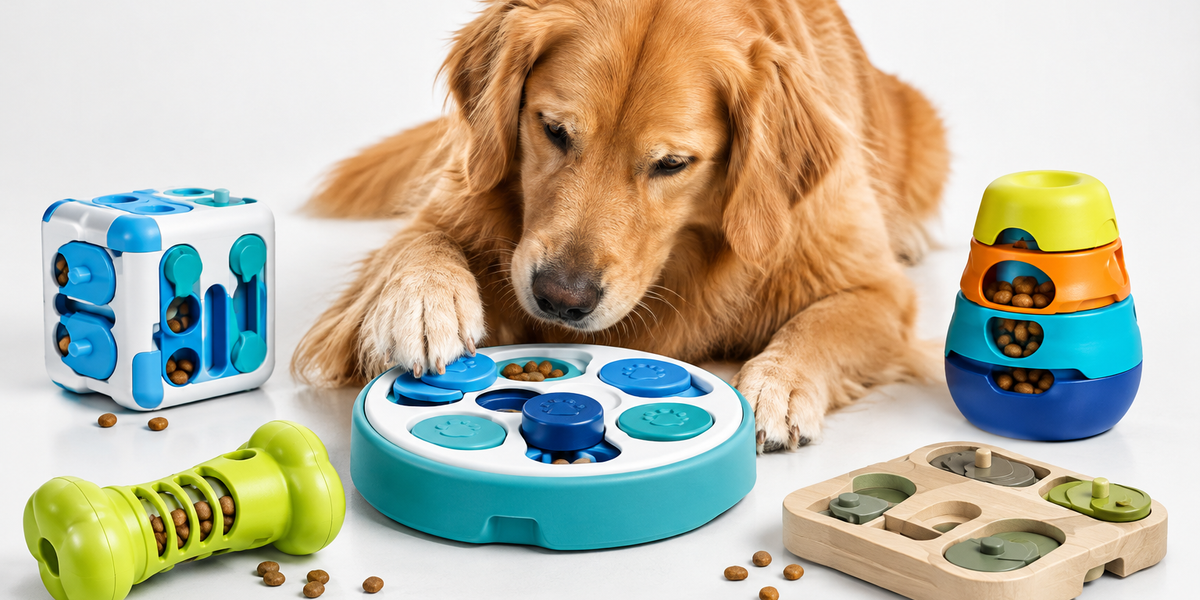
This guide covers interactive puzzles, treat-dispensing challenges, and advanced problem-solving toys specifically suited for dogs with excess mental energy. We'll show you how to match difficulty levels to your dog's experience, avoid common durability pitfalls, and rotate toys to maintain long-term engagement. If you're also building out a complete toy rotation for your active dog, our guide to choosing the right size dog toy without wasting money covers the sizing fundamentals that apply to puzzle toys too.
What to Look For
Appropriate difficulty level — Start with level 1 or 2 puzzles even for smart dogs. A toy that's too hard leads to frustration and disinterest; one that's too easy gets boring after one session. Look for toys that let you adjust difficulty by adding more compartments or changing hiding spots.
Durability for the dog's play style — High-energy doesn't always mean aggressive chewing, but many working breeds will resort to chewing if they can't solve the puzzle. Hard plastics work for most dogs; power chewers need rubber or wood construction. Check buyer reviews specifically mentioning your breed to gauge real-world durability.
Multiple problem-solving steps — The best puzzles require a sequence of actions: lift a flap, slide a panel, spin a layer. Single-action toys (push to dispense) work for short sessions but won't sustain interest in dogs who need serious mental work.
Easy cleaning and reloading — You'll use these toys daily, so they need to be dishwasher safe or simple to hand wash. Toys with hard-to-reach crevices collect grime and become gross fast. Loading treats should take 30 seconds, not 5 minutes of frustration.
Safety features — Avoid toys with small detachable parts that could become choking hazards. Check for non-toxic materials (BPA-free, phthalate-free) since your dog's mouth will be all over it. Non-slip bases prevent the toy from sliding across floors, reducing frustration and noise.
Scalability — The ideal puzzle grows with your dog. Look for designs where you can increase difficulty over time or combine with other puzzles from the same system. A $15 toy that challenges your dog for 6 months beats a $40 toy they master in a week.
💡 Pro Tip: Introduce puzzle toys before mealtime when your dog is motivated by hunger. Once they understand the concept, you can use them anytime for mental enrichment.
Outward Hound Nina Ottosson Dog Brick
| Criteria | Score |
|----------|-------|
| Difficulty Progression | 9/10 |
| Durability | 6/10 |
| Engagement Time | 8/10 |
| Value for Money | 10/10 |
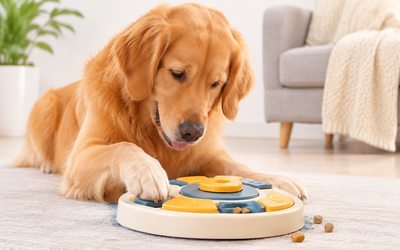
The Dog Brick remains the gold standard for multi-level puzzle engagement at a budget price. This interactive game features sliding compartments, flip-up lids, and removable bone pieces that hide treats in 9 different spots. What makes it exceptional for high-energy dogs is the layered problem-solving: they must remove the bones, flip the lids, then slide the panels to access all the rewards.
Based on verified buyer reviews, most dogs take 15-20 minutes to fully clear the puzzle on their first few attempts. As they learn the system, you can make it harder by only partially filling compartments or using less aromatic treats. The BPA-free plastic is dishwasher safe, making daily cleaning effortless.
The main limitation is durability with aggressive chewers. Several border collie and Malinois owners report their dogs cracking or chewing the plastic pieces within a few weeks. If your dog defaults to chewing rather than problem-solving when frustrated, you'll need something tougher.
✅ Pros:
- Three difficulty levels in one toy (remove bones, flip lids, slide compartments)
- Dishwasher safe for easy daily cleaning
- Under $15 makes it perfect for testing if your dog enjoys puzzles
- Non-slip base prevents sliding during play
❌ Cons:
- Lighter plastic won't survive power chewers
- Some highly intelligent dogs master it in 2-3 sessions
- Sliding compartments can become loose with heavy use
West Paw Toppl Treat Toy
| Criteria | Score |
|----------|-------|
| Durability | 10/10 |
| Difficulty Level | 6/10 |
| Versatility | 9/10 |
| Ease of Cleaning | 8/10 |
The Toppl isn't a traditional puzzle, but it's the best option for high-energy dogs who destroy complex puzzles through aggressive chewing. Made from West Paw's proprietary Zogoflex material, this treat dispenser has survived pit bulls, Rottweilers, and power-chewing German shepherds according to thousands of buyer reviews. The company even guarantees replacement if your dog damages it.
The puzzle element comes from the internal ridges and curves that make treats difficult to extract. You can stuff it with peanut butter, freeze it for hours of licking work, or fill it with kibble that dispenses slowly as the dog manipulates it. Two Toppls can interlock for increased difficulty.
For truly high-drive dogs like working-line shepherds or sport dogs, the Toppl works best as part of a rotation rather than the sole puzzle. It provides 10-15 minutes of focus, whereas multi-step puzzles can engage for 20-30 minutes. Think of it as the indestructible foundation of your puzzle collection.
✅ Pros:
- Virtually indestructible Zogoflex material with guaranteed replacement
- Freezable for extended challenge duration
- Made in USA with non-toxic, FDA-compliant materials
- Two sizes can interlock for advanced difficulty
❌ Cons:
- Less mentally challenging than multi-step puzzles
- Can roll under furniture if not supervised
- More expensive per toy than basic puzzles
Trixie Mad Scientist Turn Around
| Criteria | Score |
|----------|-------|
| Difficulty Level | 10/10 |
| Mental Engagement | 10/10 |
| Durability | 8/10 |
| Value | 6/10 |
For the border collies and poodles who solve every other puzzle in under 5 minutes, the Mad Scientist represents the ultimate challenge. This level 3 puzzle requires dogs to master multiple sequential operations: spinning layers to align openings, lifting cones, sliding panels, and flipping lids. Based on buyer feedback from owners of working breeds, even experienced dogs typically need 25-35 minutes to fully solve it initially.
The solid wood construction feels premium and handles determined paws better than plastic puzzles. The beakers and scientific aesthetic make it the best-looking puzzle toy we researched—it won't be an eyesore in your living room. Trixie's design forces dogs to slow down and think rather than just pawing frantically at every surface.
The price is steep at $43, making this a commitment purchase rather than an exploratory buy. You'll also need to supervise play since some dogs will attempt to chew the wood if they get frustrated. For breeds that need serious mental work, though, this puzzle delivers engagement that cheaper toys can't match.
✅ Pros:
- Level 3 difficulty genuinely challenges highly intelligent breeds
- Multiple problem-solving steps prevent quick mastery
- Solid wood construction feels durable and looks attractive
- Combines spinning, lifting, and sliding actions
❌ Cons:
- $43 price point requires confidence your dog won't chew it
- Requires supervision to prevent wood chewing
- May be too advanced for dogs new to puzzle toys
Kong Wobbler Treat Dispensing Toy
| Criteria | Score |
|----------|-------|
| Physical Activity | 9/10 |
| Durability | 9/10 |
| Engagement Time | 7/10 |
| Value | 10/10 |
The Wobbler combines mental and physical exercise in a single toy, making it ideal for high-energy dogs who need both outlets. This weighted, egg-shaped dispenser holds kibble or small treats that release as the dog bats, noses, and rolls it around. Unlike stationary puzzles, the Wobbler turns problem-solving into a workout.
Based on buyer data, most dogs take 15-20 minutes to empty a full Wobbler on the first few uses. The unpredictable rolling pattern keeps them engaged, and the heavy polymer construction survives enthusiastic play from large breeds. Several owners of Belgian Malinois and Australian cattle dogs report using it for daily meals to add mental stimulation to feeding time.
The main drawback is noise—this toy will bang around on hard floors. Some dogs also figure out they can simply knock it over repeatedly in the same spot rather than actually problem-solving. For the $19 price point, though, it's the best value option that combines brain and body work.
✅ Pros:
- Combines physical exercise with problem-solving
- Heavy-duty polymer survives large breed enthusiasm
- Under $20 makes it accessible for first-time puzzle buyers
- Easy to clean and refill daily
❌ Cons:
- Loud on hardwood or tile floors
- Some dogs develop a "cheat" technique of repeated tipping
- Less mentally challenging than multi-step puzzles
Outward Hound Hide N Slide Puzzle
| Criteria | Score |
|----------|-------|
| Difficulty Progression | 8/10 |
| Durability | 6/10 |
| Design Quality | 8/10 |
| Learning Curve | 9/10 |
The Hide N Slide serves as the perfect intermediate step between basic puzzles and advanced challenges. This level 2 toy features sliding compartments that must be moved in specific sequences to access treats. Unlike the Dog Brick's simpler flip-and-slide design, the Hide N Slide requires dogs to understand directional movement and cause-and-effect relationships.
Verified buyers report their dogs typically spend 12-18 minutes working through this puzzle initially, with engagement time dropping to 8-10 minutes once they master the pattern. The non-slip base is a standout feature that prevents the frustration of the puzzle sliding away mid-solve—a common complaint with competing designs.
The plastic construction is BPA-free but lighter weight than we'd prefer for truly high-energy dogs. Owners of pit bulls and German shepherds note the toy shows wear after a few months of daily use. For herding breeds and retrievers with normal jaw strength, though, it holds up well as a regular rotation toy.
✅ Pros:
- Level 2 difficulty bridges gap between basic and advanced puzzles
- Non-slip base prevents sliding frustration
- Teaches sequential problem-solving skills
- BPA and phthalate free materials
❌ Cons:
- Lighter plastic may crack under aggressive use
- Limited replay value once your dog masters the pattern
- Compartments can be difficult for some dogs to slide
💡 Pro Tip: Rotate 3-4 puzzle toys weekly rather than using the same one daily. This prevents your dog from memorizing solutions and maintains engagement over months.
Frequently Asked Questions
How long should a puzzle toy keep my high-energy dog busy?
For genuinely challenging puzzles, expect 15-25 minutes of focused engagement for first-time users. As your dog learns the system, time drops to 8-15 minutes. High-energy breeds need multiple puzzle sessions throughout the day—one 20-minute puzzle won't replace their need for physical exercise. We recommend 2-3 puzzle sessions daily combined with regular walks and play.
Can puzzle toys replace physical exercise for high-energy dogs?
No. Mental stimulation complements but doesn't replace physical exercise. Think of puzzles as the equivalent of a human doing crosswords—it's mentally tiring but doesn't provide cardiovascular benefits or muscle engagement. High-energy dogs need both: physical exercise for their body and puzzle toys for their brain. The combination prevents destructive behavior better than either alone.
My dog chews the puzzle instead of solving it. What am I doing wrong?
This usually means the puzzle is too difficult, causing frustration, or your dog hasn't learned that problem-solving gets rewards. Start with easier level 1 puzzles and guide them through the first few attempts, rewarding each correct action. Use high-value treats that motivate focus. If they're a power chewer by nature, switch to rubber or wood toys like the West Paw Toppl that can't be destroyed. Understanding material safety is important here—our rubber vs nylon dog toys guide covers which materials hold up to different play styles.
How do I know what difficulty level to start with?
Start with level 1 regardless of your dog's intelligence. Even border collies need to learn the concept of interactive puzzles before tackling complex ones. Watch how quickly they solve it: under 5 minutes means move to level 2; 15-20 minutes means it's appropriately challenging; over 30 minutes or signs of frustration means it's too hard. You can always increase difficulty by using less aromatic treats or only partially filling compartments.
Are puzzle toys safe for unsupervised play?
Most puzzles require supervision, especially during the learning phase. Dogs can chew off pieces, get their jaw stuck in compartments, or become frustrated and destructive. Once your dog understands the toy and you've confirmed they won't chew the components, short unsupervised sessions (15-20 minutes) are generally safe for non-destructive dogs. Never leave puppies unsupervised with any toy—even the most durable ones can present choking hazards.
Final Thoughts
High-energy dogs aren't hyper because they're poorly trained—they're often under-stimulated. Working breeds were developed to think critically for 8-10 hours a day, and modern pet life rarely provides that level of mental challenge. Puzzle toys bridge that gap by giving your dog's brain the workout it craves.
The Outward Hound Nina Ottosson Dog Brick earns our top recommendation for its perfect balance of challenge, durability for most breeds, and unbeatable value at $15. For power chewers, the West Paw Toppl provides indestructible engagement. And for genius breeds who demolish every puzzle, the Trixie Mad Scientist delivers the advanced challenge they need.
Start with one or two puzzles to gauge your dog's interest, then build a rotation of 4-5 toys you swap weekly. The investment pays off in calmer behavior, reduced destruction, and a mentally satisfied dog who's genuinely tired at the end of the day.
Editor's Choice
After comparing specifications and analyzing buyer feedback across dozens of puzzle toys, these are our top picks for high-energy dogs in 2026:
- Best Overall: Outward Hound Nina Ottosson Dog Brick — Multi-level challenge at an entry-level price
- Best for Power Chewers: West Paw Toppl Treat Toy — Indestructible construction with lifetime guarantee
- Best Advanced Puzzle: Trixie Mad Scientist Turn Around — Level 3 complexity for genius breeds